Table of Contents
Surface Cleaner becomes a useful sourcing question when the buyer defines a specific outcome. A multipurpose label does not prove compatibility with every finish. Build an explicit intended-surface list. This guide uses Kitchen Grease Removal Wipes as the product reference and focuses on the decision behind surface cleaner rather than assuming that a familiar pack name answers every technical question.
For a brand owner, distributor or retail buyer, the next step is concrete: Request surface-specific compatibility observations and exclusions. The checks below distinguish published details, suggested buyer observations and evidence that still needs to be requested. They are a practical development framework, not a report of testing performed on a supplied production lot.
Surface Cleaner: the published Ecoshine reference
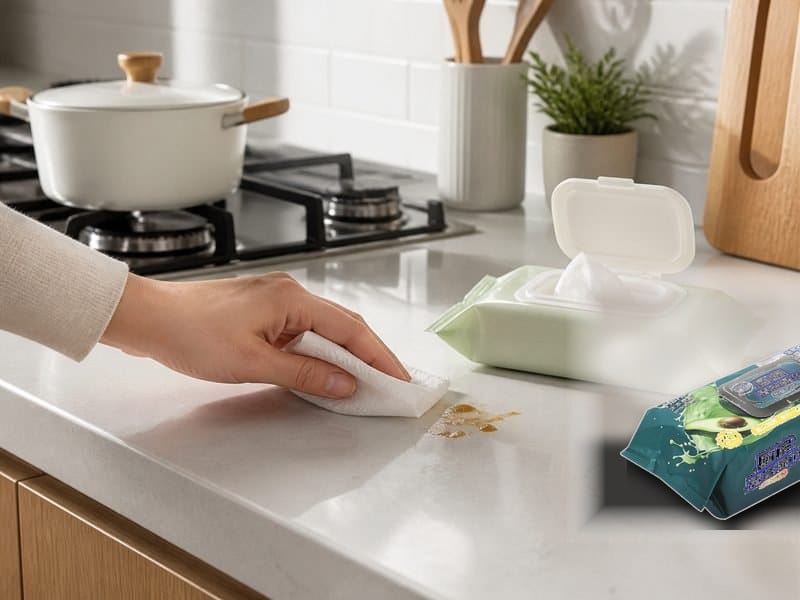
The Kitchen Grease Removal Wipes page lists 80 sheets, 20 × 20 cm dimensions and a pearl-embossed 60 GSM spunlace nonwoven. The nominal sheet area is 400 cm². It lists 24 bags per carton and a carton dimension of 44.5 × 42.5 × 26 cm. The product name describes a cleaning position, not evidence of surface disinfection or compatibility with every kitchen finish. The public table does not disclose the complete formula or a cleaning-test method. Confirm the target surfaces, residue expectations and directions before extending the product into a particular retail or commercial application. Review the current Kitchen Grease Removal Wipes page alongside the Household Cleaning Wipes range.
For surface cleaner, use this reference to start a supplier discussion, then confirm the exact configuration you want to buy. Public table values and a custom-order specification have different roles. Any missing material identity, formula information, unit or test scope should remain an explicit question until the responsible supplier or reviewer resolves it.
Surface Cleaner: Build a supported-surface list
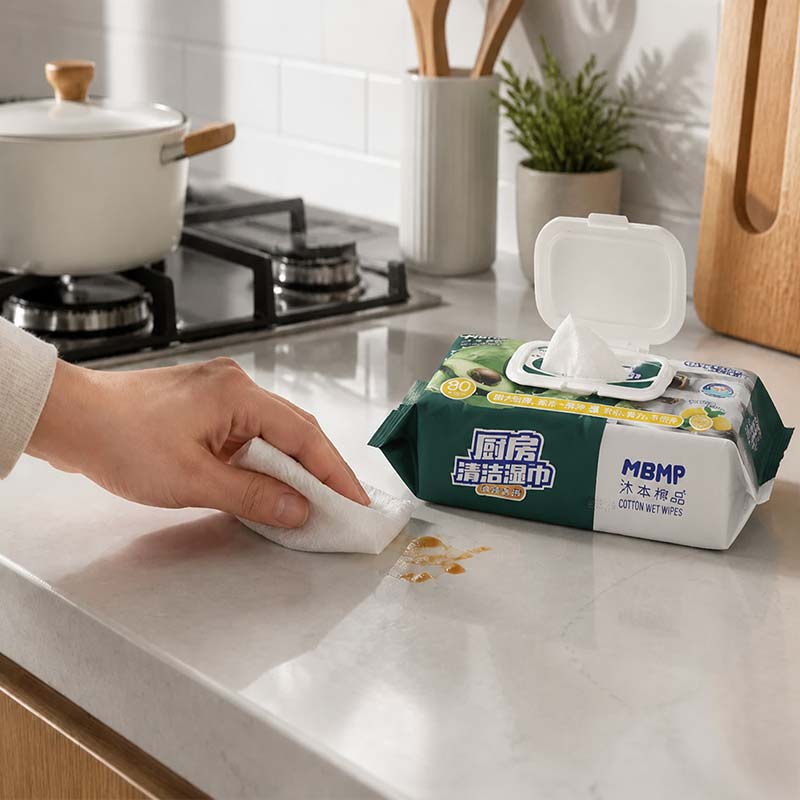
A product should be evaluated on the materials and finishes it is intended to contact. Coated wood, stone, plastic, glass, leather and painted metal are not interchangeable surfaces. For surface cleaner, list supported applications and exclusions instead of assuming that multipurpose means suitable everywhere.
Use representative panels or appropriate concealed-area checks under a defined method, following the relevant product and surface manufacturers directions. Record finish change, color transfer, streaking, swelling or another observed effect without guessing the mechanism. Keep wiping intensity and observation time consistent. A successful result on one panel does not establish suitability for every variant of that material.
Carry the supported-use boundary into directions and sales copy. For surface cleaner, a new surface application should trigger a separate review of the formula and practical evidence. Retain the approved sample and surface references where useful. The goal is a clear product fit for a defined task, with enough information for the buyer to avoid broader claims than the testing and assessment actually support.
Surface Cleaner: Define the contact area and task first
The first specification field should describe what the wipe is intended to contact and what task it is meant to perform. Skin, household surfaces, footwear, pet fur and external ear care are different applications. For surface cleaner, a convenient pack size or familiar fabric does not make one application interchangeable with another. Use the intended purpose to guide formula, packaging and evidence questions.
Write a short application statement that a supplier and reviewer can interpret consistently. Name the user or species where relevant, the contact area, the routine and the exclusions. Keep ordinary cleansing separate from treatment and antimicrobial propositions. If the proposed product serves several tasks, identify the evidence needed for each rather than relying on the word multipurpose to cover every possible use.
Carry the same application statement into the sample trial, quotation and artwork review. For surface cleaner, this prevents the product from changing meaning as different teams describe it. A sales page should not imply broader contact areas than the approved directions. If a new application is requested later, treat it as a development question with its own assessment. The existing sample can be a starting reference, but its performance in one task does not establish suitability for all others.
Surface Cleaner: Review the label as a complete user instruction
A label brings together product identity, intended use, ingredient information where applicable, directions, storage, disposal and the details required by the destination market. Review those elements together with the importer or responsible assessor. For surface cleaner, translating the front panel alone is insufficient because an attractive product name can still conflict with the practical instructions.
Check readability on the real pack. A fold, lid or seam can cover information that was clear on a flat artwork file. Small text needs enough contrast and space to remain usable after printing and handling. Make the code area identifiable and keep the retail identity consistent with carton marks. Where a restriction is central to safe intended use, it should not be contradicted by a prominent image or headline.
Keep the approved wording tied to the formula, substrate and packaging revision. For surface cleaner, a new count, ingredient or disposal statement should prompt review of the relevant parts of the label. Do not infer a destination-market requirement from a competing pack. Ask the responsible local team to confirm the actual checklist. This article identifies procurement questions and practical checks; it does not replace the market-specific assessment needed before commercial distribution.
Surface Cleaner: Translate feedback into observable criteria
A useful sample review begins with the intended task and a small number of defined questions. Soft, premium and convenient can express preferences, but they do not tell another person how to repeat the review. For surface cleaner, describe the handling action, surface or contact area, observation interval and result to record. Identify every sample by a controlled product version.
Separate technical evidence from practical observation. A buyer can compare retrieval, unfolded size, visible residue, pack feel and odor under stated conditions. Other conclusions may need the appropriate formulation, material or test documentation. Keep those approval items in the same record but in separate fields. A good visual sample should not silently clear an unresolved ingredient or claim question.
Close the review with a decision that the supplier can act on. Approve the sample, request a specific revision or hold the item pending evidence, and name the reason. For surface cleaner, retain the approved reference and attach the agreed specification. If a revision is supplied, compare the changed aspects again rather than accepting it only because the new sample looks similar. Sample feedback becomes commercially useful when it creates a reproducible production target.
Surface Cleaner: Match each conclusion to the right evidence
Different documents answer different questions. A composition declaration identifies materials, a test report records a defined assessment, and a factory certificate concerns the scope stated on that certificate. None should be silently substituted for another. For surface cleaner, list the question first, then identify the evidence needed to answer it. This keeps a procurement review from becoming a collection of impressive-looking files with unclear relevance.
Check the product identity, revision, date, method and scope on the evidence. A report for an unfilled substrate may not cover the lotion-loaded wipe. A packaging assessment may cover one film structure and closure combination. A claim about a finished product should be supported at the appropriate level. Ask who performed the work and who is responsible for interpreting its applicability to the proposed SKU. Treat missing information as a question to resolve rather than filling the gap with an assumption.
Maintain a compact evidence register beside the specification. Record what each file supports, the product version it covers and any unresolved limits. For surface cleaner, this helps the brand keep label language within the documented scope. It also makes changes easier to assess: the team can identify which files depend on a material or formula being unchanged. The article provides buyer questions and a review structure; it does not assert that a particular Ecoshine sample has passed tests that have not been supplied.
Surface Cleaner: compare the decisions side by side
The table below turns surface cleaner into a comparison that a purchasing team can review. It does not assign invented test results or supplier prices. Use it to identify which observation or file is still needed before the selected product can be approved.
| Decision | Weak comparison | Useful record |
|---|---|---|
| Separating Surface Claims from Pack Names | A product name or an isolated attractive sample | A multipurpose label does not prove compatibility with every finish. Build an explicit intended-surface list. |
| Build a supported-surface list | A broad adjective without a method | Request surface-specific compatibility observations and exclusions. |
| Define the contact area and task first | A figure with an unclear unit or product version | Record the method, sample identity and conditions. |
| Review the label as a complete user instruction | A conclusion copied from another SKU | Connect the decision to the approved finished product. |
| Commercial approval | Price accepted before open questions are resolved | Keep specification, evidence, artwork and quotation under one revision. |
Surface Cleaner: a focused sample-review example
Consider a buyer selecting Kitchen Grease Removal Wipes for a new range. The initial concern is specific: A multipurpose label does not prove compatibility with every finish. Build an explicit intended-surface list. The team first records the intended use and product revision, then uses this review step: “Build a supported-surface list.” That makes the evaluation about the actual decision rather than a general preference for one supplier.
The second reviewer takes the step “Define the contact area and task first,” while the commercial owner reviews “Review the label as a complete user instruction.” Each person records the relevant conditions and open questions. If the results disagree, the team compares the method and sample identity before averaging opinions. A quotation is then checked against the configuration that was actually evaluated.
The practical outcome for surface cleaner is one of three decisions: accept the defined version, ask for a specific change, or hold the item pending evidence. The required next action remains: Request surface-specific compatibility observations and exclusions. This example describes a review workflow. It is not a customer case study and does not claim that Ecoshine has delivered a particular measured improvement.
Surface Cleaner: prepare the inquiry and approval record
Ecoshine describes OEM/ODM support for formulation, fabric, size, packaging, sampling, production and export coordination on its service page. Use those capabilities to request a defined proposal. Include the intended market, application, reference product, required details, acceptable alternatives and the evidence questions raised here. Confirm current commercial terms directly rather than assuming a website example fixes MOQ, pricing or delivery.
Before releasing production, connect the selected sample, technical specification, evidence references, artwork and quotation. Keep unresolved questions visible and assign an owner to each. For additional background, consult EPA explanation of cleaning, sanitizing and disinfecting. That reference is general guidance and is not evidence of certification, approval or test performance for an Ecoshine SKU.
To discuss surface cleaner, send Ecoshine a short brief naming Kitchen Grease Removal Wipes and the outcome you need. Include this request: “Request surface-specific compatibility observations and exclusions.” Ask which sample and documents the team can provide for that specification, then agree the next review step before approving bulk production.
Surface Cleaner: frequently asked questions
What should a buyer confirm first about surface cleaner?
For surface cleaner, a multipurpose label does not prove compatibility with every finish. Build an explicit intended-surface list. Start with the intended use and the exact product version before comparing a pack count or price.
Which Ecoshine product is the reference for surface cleaner?
This guide uses Kitchen Grease Removal Wipes. Its public specification is a starting point; confirm the formula, material identity and packing for the actual order.
What evidence should be requested for surface cleaner?
Request surface-specific compatibility observations and exclusions. Check that any supplied file identifies the relevant finished product and its scope.
How can samples be compared for surface cleaner?
Use the step “Build a supported-surface list” and keep sample identity, method and conditions recorded. Separate practical observations from technical conclusions requiring other evidence.
What should be approved before ordering for surface cleaner?
Agree the intended use, final sample, specification, relevant evidence, artwork and quotation. Complete the check “Review the label as a complete user instruction” before production release.